Treatment of epilepsy.
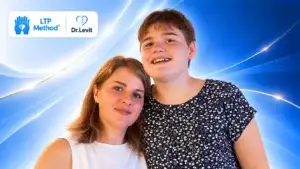
It's hard to believe that just two years ago, this boy couldn't cope without powerful antiepileptic drugs and was severely delayed in his development. Thanks to Lev Levit's treatment, Tim stopped taking the medications, as his seizures subsided completely. Moreover, he began to develop intellectually, interacting with people and his peers at school. He sings beautifully and plays the guitar.
— Tell me, can you sing songs? What do you like to do?
— I love to sing.
— Do you play the guitar?
— Only (inaudible.)
— What else can you do? Can you sing songs?
- Can.
— What songs will you sing?
- All sorts of things that are needed.
— Please tell me, when you came to us, what condition was the child in?
— We came to the clinic two years ago.
— What is the diagnosis?
— Diagnosed with epilepsy.
— Mental retardation?
- Mental retardation.
— How long did the epileptic seizures last?
— They were severe, there were 6 attacks a day.
— How did he behave after the attacks?
— I felt really bad, I needed to sleep.
— Did he take any medication?
— I was taking psychotropic medications.
— How many pills a day?
— At first, 1 in the morning, 1 in the evening. Then 1,5 in the morning, 1,5 in the evening.
— What drug?
- Tegretol.
— What was its development?
— I was very far behind.
— What was your mood?
"He was nervous, constantly aggressive. And he was mentally retarded; he couldn't read; he knew some letters, but he'd forget them, then remember them..."
So we started treatment. We gradually tapered off the medications, right? He started taking them less often. How did his condition develop? What changed during the treatment?
— Almost everything began to change.
- What exactly?
— The attacks have passed – now there are practically no attacks.
— Are we not giving medication now?
"No, we haven't given him any medication for a long time. And his development has been really remarkable. He can read. His counting skills are still weak, but he's already able to do some calculations. Before, he didn't understand what anyone wanted from him at all."
— How did he start behaving in his environment – with those around him?
- I can send him to the store, he will buy it without any problems.
— A product, huh? He started playing the guitar?
— He started playing the guitar. And he started communicating with people normally. People talk to him.
— Was he able to talk to people around him before?
— No, before, if someone approached him, he would somehow become wildly distant, and it was difficult for a stranger to communicate with him.
- And now?
- And now peace be with the neighbors and with all the people.
— Who do you know among your neighbors, Tim? Do you know all your neighbors, your friends? Do you have any friends, Tim?
— Only at school. (I didn't understand the rest)
— Tell me what else has changed in him – development, intelligence, communication?
"Yes, everything has changed. He's become a completely different person. I can now communicate with him calmly, like a normal person. I couldn't communicate with him two years ago; I had to adapt to him—to his nerves, to his development—everything had to be taken into account, calculated. Now I treat him calmly, like I do with everyone."
— And there are no seizures, right?
- Нет.
— Have you done the examination?
- Yes, we did an examination.
- Show it to me.
— What did you do? What tests did you perform?
- AJ.
- Here you go, we'll show you all.
"We're very happy with the treatment. Absolutely delighted. It's what we needed. What we wanted."
— Have you stopped taking your medications?
- Yes.
— Are there any cramps now?
- No cramps, nothing.
— Has the child made any intellectual progress?
- Yes.
— He became reasonable, understanding... I heard him sing (inaudible.)
- Sings.
— Are they calling him?
— They call him. He sings both at school and at all the concerts where he's a soloist.
- Good.
— I also forgot to say that the left side of his forehead was narrower, but now it’s evened out.
— Lift it up, show it again. What was there? Was it narrowed?
— It was narrowed. On the left side it was much narrower.
— It's leveled out now, right?
— Now it's leveled out.
- Very good. And do you play games on (inaudible.)
— Maps.
— What cards do you play? TV games?
— Maps on TV and on (inaudible)
— Excellent. Chess? Do you play chess?
— On TV.
- Well done.