Stims in autism are one of the most common and noticeable signs of ASD.That's why many parents ask:
"Why is my child flapping his arms like wings? Is it stimming? Should I stop it?"
In this article, we'll take a detailed look at what stims are in autism, why they occur, when they can interfere with development, and how parents can gently help their child.
Stims in children with autism: What they are, what causes them, and what parents can do
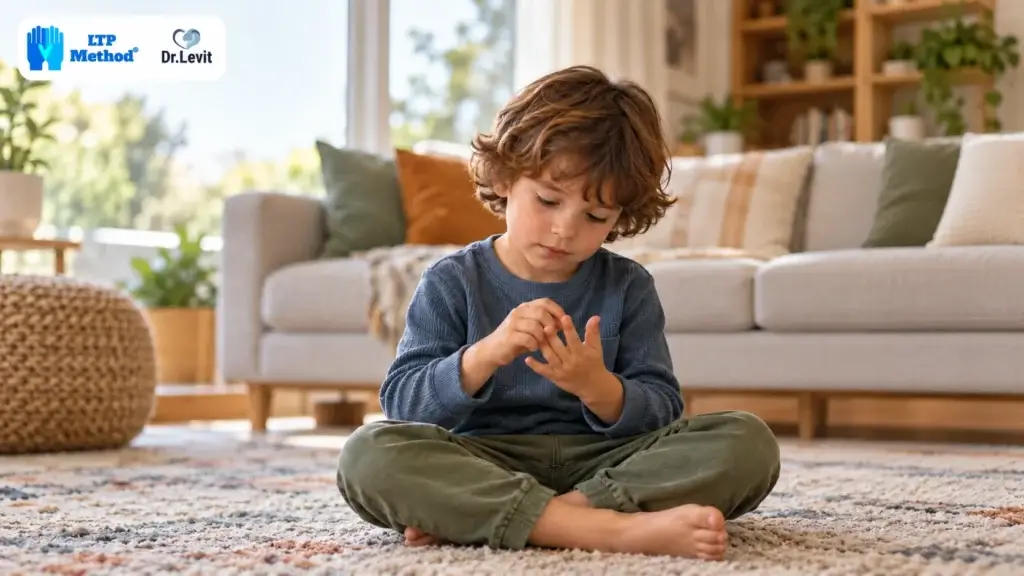
Does your child flap their arms like wings, rock, jump, or repeat the same sounds or movements? Parents often notice this behavior and ask questions: What are stims, why do they occur in children, and are they related to autism?
Such repetitive actions are often referred to as stims , and the behavior itself is referred to as stimming.
Stimuli can become especially noticeable during times of joy, excitement, fatigue, anticipation, or sensory overload. It's important not just to try to stop the child's movements, but to understand what's happening to them at that moment and what function this behavior serves.
Let's take a simple look at what stims are in children, what types there are, why a child waves their hands, and when parents should pay special attention to this.
What are stims in simple terms?
Stims are repetitive movements, sounds, or actions that can help a child cope with emotions, arousal, or sensory overload.
For example, a child may:
- wave your arms;
- swing;
- bounce;
- spin;
- to move one's fingers;
- repeat sounds;
- shake your hands;
- spinning or looking at objects for a long time.
Some children start doing this when they're very happy. Others do it when they're anxious, tired, or in an unfamiliar environment.
Therefore, the movement itself is only what the parent sees. To understand its meaning, it's important to pay attention to the situation in which it occurs.
What is stimming?
Stimming (from the English word stimming) is a term used to describe repetitive self-stimulating behavior.
In Russian speech, individual manifestations of such behavior are often called stims.
Certain repetitive behaviors are not unique to children with autism spectrum disorders. For example, a person might tap their foot, fidget with a pen, or pace around the room when agitated.
However, in ASD, repetitive movements and actions may be much more pronounced, frequent, and noticeable.
Therefore, it is important to evaluate not only the presence of stims, but also how often they occur, in what situations, and whether they interfere with the child’s daily life.
What types of stims do children have?
Stimming can look completely different. For one child, it's primarily hand movements, while for another, it may involve sounds, rocking, or handling objects.
Motor stimuli
These may include:
- arm swings;
- shaking of hands;
- body rocking;
- jumping;
- spinning;
- repetitive finger movements;
- walking along a certain trajectory.
Vocal stimuli
The child can:
- repeat one sound;
- hum;
- to hum;
- make repetitive sounds;
- repeat individual words or phrases over and over again.
It is important to distinguish this behavior from the speech that a child uses to address another person and communicate.
Visual stimuli
For example:
- look at rotating objects for a long time;
- observe the movement of light;
- look at objects from a certain angle;
- observe the same movement repeatedly.
Tactile stimuli
This may include repeated touching of certain surfaces, objects, hair, clothing, or one's own body.
Not all stims necessarily look the same, so what's more important is not the name of a specific movement, but the reason for its appearance and its function for the child.
Stims for autism
In autism, repetitive movements, actions, or interests may be one of the child's behavioral characteristics.
But it is important to understand: it is impossible to determine whether a child has autism or not based on stims alone.
To assess ASD, specialists look at a combination of developmental and behavioral characteristics: social interaction, communication, interests, repetitive behavior, and other signs.
Therefore, if a child simply waves his arms when he is very happy, this in itself does not mean that he has autism.
It's a completely different situation when parents simultaneously notice difficulties with communication, understanding spoken language, contact, adaptation to change, and other developmental characteristics.
Why does a child flap his arms like wings?
One of the most frequently asked questions from parents:
"Why does the child flap his arms like wings?"
This movement may indeed be one of the variants of stimming.
Parents especially often notice it when the child:
- rejoices;
- very excited;
- waiting for something nice;
- is worried;
- feels anxious;
- finds himself in an unfamiliar environment;
- is faced with a large number of impressions;
- cannot express his condition in words.
For example, a child sees a favorite toy and begins flapping their arms rapidly. Or they enter a noisy, unfamiliar room and begin flapping their arms in a similar manner.
Outwardly the action is the same, but the reasons in these two situations can be completely different.
This is why it is important to look not only at the child’s hands themselves, but at what happened immediately before the movement appeared.
Why does a child wave his hands when he is emotional?
Sometimes parents notice that a child waves his arms mainly when he is happy or very excited.
The emotion can be so intense that the child expresses it not only with facial expressions or words, but with his whole body.
Therefore, arm swings may appear:
when happy → when expecting → when excited → when anxious → when overloaded.
If a child has difficulty communicating with words like “I’m happy,” “I’m scared,” “it’s too loud,” or “I’m tired,” their state may be more noticeable through their behavior.
For parents, this is an important tip: instead of asking one question , "How do I stop this movement?" it's more helpful to first ask another:
"Why is it appearing now?"
Why do stims occur in children?
There's not always a single, universal cause for stimming. Its severity can be influenced by various factors.
1. Strong emotions
Joy, excitement, fear, anticipation and anxiety can be accompanied by repetitive movements.
2. Sensory load
A large number of sounds, people, lights, touches, or other stimuli can be challenging for a child.
Repeated action in such a situation can help him regulate his condition.
3. Search for specific sensations
Some children, on the contrary, strive to receive additional motor, visual or tactile stimulation.
4. Communication difficulties
If a child has difficulty communicating their condition verbally or in another understandable way, those around them may notice a change in behavior first.
5. Fatigue and stress
Pay attention to whether the stimuli intensify after a busy day, lack of sleep, a lot of activities, or a change in your usual routine.
Such observation sometimes helps to see a pattern.
Should I remove my child's stims?
You shouldn't set yourself the goal of stopping every repetitive movement at any cost.
First, it is necessary to understand its function.
Simply holding a child's hands, constantly making comments, or telling them to "stop" won't necessarily make the underlying cause of the behavior go away.
You should be especially careful when dealing with the situation if the stims:
- lead to injuries;
- interfere with the child's ability to eat or sleep;
- almost constantly interfere with interaction with others;
- interfere with learning or daily activities;
- suddenly became much more intense;
- accompanied by a marked deterioration in condition or behavior.
In such cases, it is important to understand what exactly has changed and why the behavior has intensified.
Did you recognize your child in at least a few points?
Don't try to tackle each difficulty separately. During a free consultation, a specialist will help you look at your child's situation holistically and determine where to begin.
What should parents do if their child starts using stims?
The first thing you can do is start observing.
Try to mark for a few days:
What happened before Steam? → What did Steam look like? → How long did it last? → What happened after?
For example:
guests arrived → it became noisy → the child began to rock → went into a quiet room → calmed down.
Или:
saw dad → was happy → started waving his arms → after a minute the movement stopped.
These two situations appear completely different in terms of cause, although the repetitive motion itself may be similar.
Such a diary helps to see patterns and better understand the child’s condition.
When do stims require extra attention?
Seeking a professional evaluation is especially important if the repetitive behavior is accompanied by other developmental difficulties.
For example, if a child:
- does not respond to name;
- hardly uses gestures to communicate;
- does not ask parents for help;
- does not understand simple requests;
- rarely initiates interaction;
- loses previously acquired skills;
- experiences significant difficulties in everyday life.
In such a situation, it is not the individual stimulus that matters, but the overall picture of the child’s development.
How do they work with stims in the LTP® method?
The LTP® method focuses not only on the external manifestation of the child's behavior.
The goal is to understand in what situations stimuli are amplified, what is happening to the child, and what factors can influence his condition and interaction with others.
Work at LTP® includes several areas.
Power stabilization
Parents receive recommendations on how to organize their child's nutrition and gradually work with food selectivity.
Vitamin therapy
The next stage of the program is carried out according to individual recommendations of specialists.
Psychotherapeutic consulting
Parents learn to observe their child's behavior, better understand their reactions, and build interactions in everyday situations.
The goal is not to mechanically prohibit a child from waving his arms or rocking, but to understand the reasons for the behavior and work with the child’s development in a comprehensive manner.
The most important thing parents need to know
Stims are repetitive movements, sounds, or actions. Stimming can occur in different children, and in autism, it can be a noticeable behavioral feature.
If a child flaps his arms like wings, swings, or repeats the same actions, you should not evaluate only the movement itself.
It is much more important to understand:
when it occurs → what precedes it → what function it performs → does it interfere with the child's daily life.
And if, along with stims, parents notice difficulties with speech, understanding, communication, behavior, or other developmental issues, the situation should be considered comprehensively.
Would you like to understand your child's situation in more detail?
If you notice stimuli, difficulties with speech, understanding, communication or behavior and don’t know where to start, you can take a free online consultation with an LTP® specialist.
During the consultation, the specialist will examine the child's situation in more detail, discuss existing difficulties, and discuss possible next steps.
Frequently asked questions from parents about Steam
If a child waves his arms, is it autism?
No. This symptom alone is not enough to conclude that a child has autism. The combination of the child's developmental and behavioral characteristics is important.
Do only autistic people have stims?
No. Repetitive behaviors can also occur in people without ASD. In autism, they may be more pronounced or more often interfere with daily activities.
Why do stimuli increase when a child is happy?
Strong emotional arousal can be accompanied by motor reactions. This is why some children begin jumping, flapping their arms, or performing other repetitive movements precisely when they are feeling joyful.
Is it possible to prohibit a child from stimming?
Simply prohibiting a behavior doesn't explain its cause. It's important to first understand why the child needs this action and whether it's a response to stress, overload, or strong emotion.
Can stims change over time?
Yes. As a child develops, the nature, frequency, and severity of repetitive behavior may change.
🔎 There are stims. But what else is happening with the child?
If a child is rocking, flapping their arms, walking on their toes, or constantly repeating the same actions, it's easy to focus solely on the stimuli. But it's much more important to consider what's happening with speech, comprehension, communication, and overall development.
🧩 “He waves his arms, spins, walks on his tiptoes… Is this autism?”
Steam alone does not provide an answer.
But if the child does not respond to his name, does not point, avoids contact, rarely addresses you, or prefers repetitive actions, it is important to look at the combination of signs.
👉 What signs of autism are important to evaluate together, not separately?
💬 "He's stimulating and barely speaking. Should I just wait until he can speak?"
Sometimes a child has words: they name colors, numbers, animals, or repeat entire phrases. But they don't ask questions, make requests, or use language when they need something.
The number of words does not yet indicate how well a child can communicate.
👉 Why does a child know words but still not use speech to communicate?
💙 "We've been diagnosed with mental retardation. So where do the stimuli and communication issues come from?"
Speech delays, difficulties with comprehension, unusual movements and behavioral characteristics can appear similar in different developmental disorders.
Therefore, parents often do not understand: is this a developmental delay, signs of ASD, or one condition combined with another?
👉 Autism and mental retardation: what's the difference and why are they so easily confused?