Why does a child know words but not understand spoken language?
Many parents notice that their child already knows dozens or even hundreds of words, can repeat phrases, answers familiar questions, and is working with a speech therapist.
But at home the situation looks completely different.
Child:
❌ does not always respond to name;
❌ does not understand simple requests;
❌ rarely addresses loved ones himself;
❌ does not ask for help;
❌ does not transfer new skills into everyday life;
❌ uses speech only in familiar situations.
And a natural question arises:
Why does a child speak, but real communication does not occur?
The answer is that speaking words and understanding spoken language are two completely different processes.
What is understanding of spoken language and why does a child not understand spoken language?
🧠 Understanding spoken language is a child's ability to understand the meaning of an adult's words and act in accordance with them.
This means that the child is able to:
✔️ understand the request;
✔️ follow the instructions;
✔️ respond to the name;
✔️ respond according to the situation;
✔️ understand the question;
✔️ Use speech consciously.
Understanding speech becomes the foundation for full communication.
Why doesn’t a child understand spoken language, even though he can speak?
Sometimes a child is able to:
🗣️ repeat words;
🗣️ pronounce long phrases;
🗣️ recite poems;
🗣️ respond with template answers.
However, this does not mean that he understands the meaning of what was said.
Without understanding spoken language, it is difficult for a child to:
- carry out new instructions;
- use speech independently;
- maintain dialogue;
- communicate in new situations;
- transfer skills beyond the specialist's office.
However, vocabulary alone does not guarantee full communication.
How does a speech therapist's work differ if the child does not understand speech?
The work of a speech therapist plays an important role in a child's speech development. However, the goals of speech therapy and the LTP method differ.
Comparison of approaches
| Speech therapist-defectologist | LTP method |
|---|---|
| 🗣️ Speech development | 🧠 Developing understanding of spoken language |
| 🔤 Sound production | 👂 Forming a response to a name |
| 📖 Vocabulary expansion | 🤝 Developing communication initiatives |
| 💬 Sentence construction | 🏡 Transferring skills to everyday life |
| ✍️ Working on speech skills | ❤️ Developing a desire to interact |
| 🎯 Work mainly in the office | 🌍 Using skills at home, on walks, and in everyday life |
It's important to understand that these approaches are not mutually exclusive . In many cases, speech therapy is an important part of helping a child. However, if they lack understanding of spoken language and basic communication skills, it can be difficult for them to use their acquired speech skills in everyday life.
Why do new skills remain only in classes?
This is one of the most common situations that parents face.
📍 During class the child:
✅ answers questions;
✅ completes tasks;
✅ repeats words;
✅ Interacts with a specialist.
But at home, parents continue to observe the same difficulties.
Why is this happening?
Because the child has not yet learned to independently use new skills outside of the learning situation.
Therefore, the LTP method places great emphasis on transferring skills to the natural environment.
Skills are reinforced:
🏡 at home;
🚗 on a walk;
🛒 in the store;
👨👩👧👦 while communicating with family;
🧸 during the game.
It is in everyday life that a child begins to use speech as a means of communication.
What skills help a child understand spoken language?
The LTP method emphasizes the development of basic communication skills.
These include:
✅ understanding of addressed speech;
✅ response to name;
✅ joint attention;
✅ understanding of everyday requests;
✅ initiative of communication;
✅ using speech for its intended purpose;
✅ desire to interact with others;
✅ transfer of new skills to various life situations.
It is these abilities that become the foundation for the further development of speech.
Why is speech comprehension more important than word count?
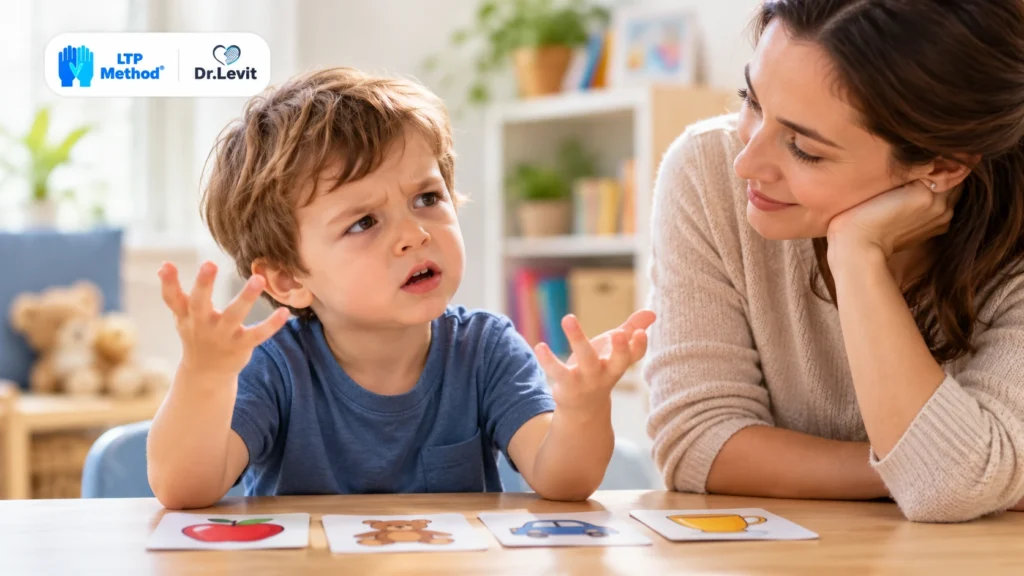
💡 Imagine an adult who knows thousands of foreign words, but has absolutely no understanding of what is being said to him.
A full conversation will be impossible.
A similar situation can be observed in a child.
Therefore, the task is not only to increase vocabulary, but also to develop the ability to understand the speech of others and use one's own speech as a communication tool.
When should you seek advice?
Consulting a specialist may be helpful if your child:
- does not understand speech addressed to him;
- responds poorly to name;
- knows words, but hardly uses them to communicate;
- does not transfer skills home after classes;
- does not fulfill simple requests;
- rarely addresses adults independently;
- experiences significant communication difficulties.
During the consultation, a specialist will help you understand which factors may influence your child's development, answer your questions, and suggest the best steps to take in your specific situation.
📞 Sign up for a consultation
Every child develops differently, so there is no one-size-fits-all solution.
If you want to understand why your child knows words but doesn't understand spoken language , and learn what steps might help in your particular case, schedule a consultation with a specialist at Dr. Levit Clinic.
During the consultation you will be able to:
✅ discuss in detail the child’s developmental characteristics;
✅ get answers to your questions;
✅ learn more about the principles of the LTP method;
✅ determine the optimal sequence of further work.
Submit a request for a free consultation, and a specialist will contact you to help you understand your specific situation.
❓ Frequently Asked Questions (FAQ)
Can a child speak but not understand speech?
Yes. A child may repeat words, use memorized phrases, or respond according to a template, but still have difficulty understanding the speech of others.
Why does a child complete assignments with a specialist, but not at home?
This is possible if the skill was developed only in a classroom setting. To consolidate it, it's important to learn how to use it in everyday life.
Should I stop speech therapy if I am using the LTP method?
No. The LTP method does not replace speech therapy. Its purpose is to help develop basic communication skills, which will make it easier for the child to use speech in real life.
How can you tell if your child has begun to understand spoken language?
Most often, parents notice that the child:
✔️ responds to name faster;
✔️ begins to carry out requests without constant prompting;
✔️ Understands questions better;
✔️ more actively addresses adults;
✔️ uses speech more often in everyday life.
At what age can you start working?
The sooner parents pay attention to their child's developmental characteristics and receive a professional assessment of the situation, the sooner the most appropriate strategy for further assistance can be determined.