Why doesn't a child play with toys the way adults expect?
When a child doesn't play with toys , many parents become concerned and wonder if this is normal. This behavior is especially common in children with autism (ASD), developmental delay (DPR), speech delay (ZPR), and ADHD . Instead of pushing a car, the child may spend hours spinning its wheels, lining up toys, or showing no interest in play. This behavior doesn't always mean the child isn't interested in the toys. More often than not, the cause lies in the developmental differences in play skills.
The child receives new toys, but uses them in a completely different way than his peers.
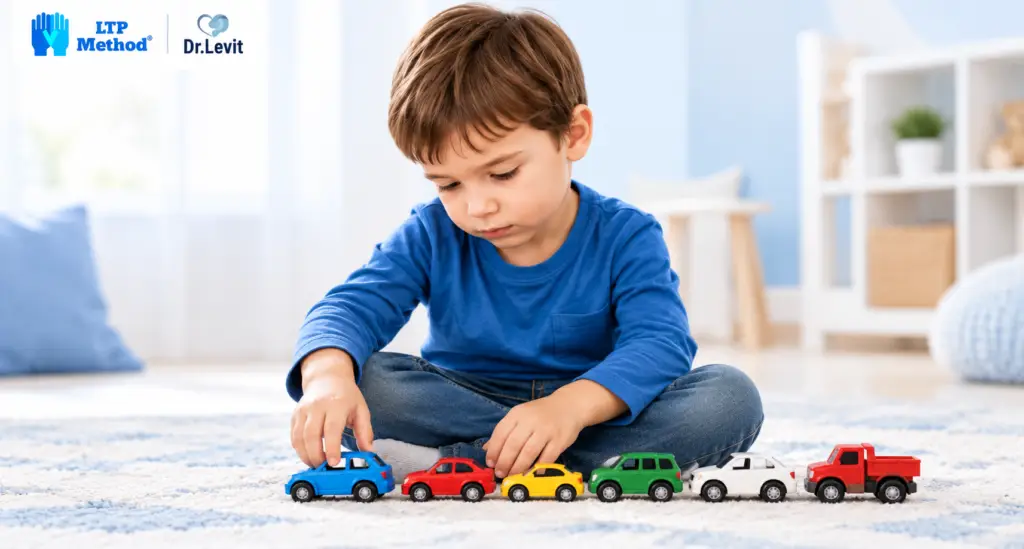
🚗 Instead of rolling the car along the road, he spends hours spinning its wheels.
🧱 Instead of building a tower, he carefully arranges the cubes in long rows.
🧸 Instead of feeding the doll, putting her to bed, or making up a story, she simply moves the toys from place to place.
Sometimes a child may not show any interest in toys and prefer household items: lids, strings, boxes, spoons or packaging.
Parents are naturally worried.
"Why doesn't my child play?"
"He's not interested in toys?"
"Maybe that's just how he is?"
In fact, more often than not, the problem isn't a lack of interest at all.
This is due to the fact that playing is a complex skill that develops gradually and goes through several important stages.
Play is not an innate ability
Many adults perceive play as something natural.
It seems that it is enough to buy a child a toy, and he will start playing on his own.
But the game develops in a completely different way.
🧩 Play skills develop gradually, as the nervous system matures, experience accumulates, and an understanding of the surrounding world develops.
Each subsequent stage builds on the previous one.
If one of them is not sufficiently developed, it becomes difficult for the child to move on.
Therefore, the absence of a story-based game does not always mean that the child does not want to play.
Often this means that he still lacks certain skills.
How does play develop in a child?
The development of a game usually goes through several successive stages.
1. Use of the item for its intended purpose
At this stage, the child begins to understand what the object is intended for.
🚗 The car is driving.
🥄 They eat with a spoon.
🧸 The doll can be seated.
⚽ The ball can be rolled or thrown.
It seems simple, but this is where the understanding of the function of objects is formed.
2. Simple game actions
After this, individual game actions appear.
For example:
- take the car for a spin;
- feed the doll;
- put the toy to bed;
- open and close the garage;
- put a passenger on the bus.
The child begins to understand the cause-and-effect relationships between his actions and what is happening.
3. Small game plots
The next step is to combine several actions into a sequence.
For example:
🚙 The car arrived home.
👨 Dad came out.
🍽️ The family had dinner.
😴 Everyone went to bed.
This is where the story game comes in.
4. Imagination and independent play
Later, the child begins to invent stories on his own.
Toys become characters.
Roles, emotions, dialogues and different possible developments appear.
This type of game is considered one of the important foundations for the further development of thinking, communication and speech.
Why does a child spin wheels, line up toys, or repeat the same action?
In children with autism (ASD), delayed speech development, delayed speech development and delayed mental development, such features are quite common.
This does not mean that the child “can’t play” or that he will never learn to play.
Most often, this indicates that the development of gaming skills has stopped at a certain stage.
For example:
🚗 the child is focused only on individual parts of the toy;
📦 It is easier for him to perform repetitive actions;
🔄 Identical movements help you feel predictable and safe;
🧠 It's difficult for him to understand how to combine individual actions into a complete game.
So he repeats the same scenario over and over again.
Why doesn't the child play with toys and why is play so important?
Many people consider the game to be just entertainment.
In fact, it is during play that a child masters a huge number of skills.
Through play he learns:
💙 understand the world around us;
💙 establish contact with adults;
💙 interact with peers;
💙 concentrate attention;
💙 follow instructions;
💙 understand cause-and-effect relationships;
💙 develop imagination;
💙 expand vocabulary;
💙 prepare for speech development.
This is why the development of play is one of the important components of a child’s overall development.
If a child doesn't play with toys, can he be taught to play?
Yes.
But it's important to understand that game development rarely happens on its own if the basic skills haven't yet been formed.
A common mistake is to try to teach a child complex stories right away.
For example, parents suggest:
— feed the doll;
— take the car to the store;
— to have a tea party.
But if the child has not yet mastered the previous stages, such tasks turn out to be too difficult for him.
As a result, adults become upset and the child loses interest.
It is much more effective to move gradually, moving from simple actions to more complex ones.
It is consistency that allows you to develop sustainable gaming skills.
How is play development addressed in the LTP® method?
In the LTP® method , play is not seen as a separate activity, but as an important part of a child’s overall development.
We teach parents how to develop play skills step by step without pressure, coercion, or constant demands.
🌿 The work is built gradually, taking into account the child's age, their current capabilities, and already developed skills.
Parents learn:
- understand what stage of play development the child is at;
- choose tasks that match his level;
- gradually make game actions more difficult;
- to generate interest in playing together;
- use play to develop understanding of speech, communication, attention and interaction.
This approach helps not only increase the number of game actions, but also makes the game more meaningful and useful for further development.
Conclusion
Just because a child doesn't play with toys doesn't mean they'll never master story-based play. With the right approach, play skills develop gradually.
🌱 Very often, an unusual game only indicates that certain stages of its development have not yet been formed.
With the right and consistent approach, play skills can gradually develop, and along with them, understanding of spoken language, communication, attention, and interaction with others often improve.
💙 If you want to understand why your child isn't playing with toys and learn the best way to start developing play skills, schedule a free consultation with specialists at Dr. Levit Clinic. We'll help you determine your child's current development level and suggest possible next steps.
💙 Sign up for a free consultation
If your child doesn't play with toys, constantly repeats the same actions, spins wheels on cars, lines up objects, or shows no interest in story-based play , don't expect things to change on their own.
During a free consultation, Dr. Levit Clinic specialists will help you:
✅ understand what stage of development of gaming skills your child is at;
✅ Explain the possible reasons for the lack of a story-driven game;
✅ assess which basic skills have already been developed and which require development;
✅ suggest where it’s best to start in your particular situation;
✅ Answer all your questions about the LTP® method.
📞 The consultation is online, free, and without any obligations.
Leave a request on the website, and we will contact you to find a convenient time.
Frequently Asked Questions (FAQ)
Why does a child with autism spin the wheels of a car instead of playing?
Many children with autism (ASD), developmental delay (DPR), speech delay (ZPR), and delayed speech development (DPR) may focus their attention on individual parts of objects rather than on their functional use. This is a common developmental feature of play skills and does not mean the child will never learn to play differently.
At what age should a child start playing story games?
In children with typical development, the first simple story elements usually appear around 1,5 to 3 years of age . However, the timing may vary. If a child has a developmental delay or ASD, the development of story-based play may occur much later and often requires targeted adult support.
Should you force your child to play with toys?
No. Pressure rarely produces positive results. It's much more effective to gradually build interest in playing together and offer tasks that are appropriate to the child's current developmental level.
If a child lines up toys, is this always a sign of autism?
No. This behavior alone cannot be used to make a diagnosis . Some children occasionally line up their toys and still develop normally. It's important to evaluate the entire developmental picture: speech comprehension, communication, social interaction, behavior, play development, and other characteristics.
Could the lack of play be related to speech delay?
Yes. The development of play, speech comprehension, and communication are closely interconnected. If a child has difficulty understanding what's happening around them or interacting with others, this may also impact their play skills.
How does the LTP® method help develop play?
The LTP® method provides parents with step-by-step recommendations for developing play skills tailored to their child's level. The process is sequential, moving from simple manipulations with objects to more complex play scenarios. Attention is paid not only to play but also to creating conditions that promote the child's overall development.
Can a child learn to play if he is not interested in toys at all now?
In many cases, yes. By identifying the child's current developmental level, selecting appropriate tasks, and engaging in consistent practice, play skills can gradually develop. The rate of change is always individual and depends on the specific needs of each child.
What to do if a child prefers household items to toys?
This behavior is quite common. Don't immediately ban your child's interest in everyday objects. It's better to understand what attracts your child and gradually use this interest to develop shared play and learn new activities.
Is it possible to develop the game at home on your own?
Yes. Parents spend the most time with their child, so their involvement is key. It's important to understand which skills to develop first and how to structure activities so they match the child's abilities and don't overwhelm them.