The child does not speak: when should I worry and what should I do?
The question "If my child doesn't speak, is it autism?" is one of the most common questions from parents who notice a speech delay in their son or daughter. If a two- or three-year-old child barely speaks, says only a few words, or doesn't use speech at all, the concern is understandable.
"He's already two years old, and he barely speaks."
"At three years old there are only a few words."
"He understands everything, but he doesn't speak."
"The child doesn't respond to his name. Is this autism?"
Parents very often turn to specialists with such questions.
And the first thing that is important to understand is that the absence or delay of speech in itself does not mean that the child has autism.
Speech development can be delayed for various reasons. But if, along with the lack of speech, parents notice difficulties with comprehension, communication, gestures, joint attention, play, or behavior, it's important to assess the child's development holistically.
Let's figure out what you should really pay attention to. 👇
❓ A child who doesn't speak is autistic: what's important to understand?
No. A non-verbal child is not necessarily a child with autism.
Autism spectrum disorder (ASD) is not defined by a single symptom. When diagnosing, specialists evaluate not only the presence of speech but also the child's social communication, interaction, and behavior.
Therefore, the question “if a child doesn’t speak, it’s autism” cannot be resolved simply by counting the number of words spoken.
It is much more important to understand:
- how a child addresses adults;
- is trying to attract attention;
- does he use gestures;
- does he understand speech;
- does it respond to the name;
- does he share his interest;
- does he try to involve parents in the game;
- does he use his gaze to communicate?
That is, situations:
"the child does not speak"
и
"the child has autism"
— are not the same thing.
A more informative question would be:
How does a child communicate with others if he or she cannot yet speak fully?
This is what can provide significantly more information about its development.
🗣 What's more important than word count?
Parents often start counting words:
"Says five words."
"There is only 'mama' and 'give'."
"Names animals, colors and numbers."
But the mere presence of individual words does not yet indicate how the child uses communication.
For example, one child still speaks little, but:
- looks at mom to share the emotion with her;
- points with a finger at an object of interest;
- brings a toy to show it;
- calls an adult;
- uses gestures;
- understands simple requests;
- tries to explain what he wants;
- interested in the other person's reaction.
Another child may have even several dozen words, but at the same time he:
- rarely addresses people;
- hardly uses speech for dialogue;
- repeats phrases heard;
- answers the wrong question;
- rarely shows anything to another person to share an interest;
- does not always respond when called;
- uses words mostly mechanically.
Therefore, when parents ask, “If a child doesn’t speak, it’s autism ,” it’s important to look beyond the number of words.
Speech is part of a much larger system of communication.
🔍 Speech delay or autism: what's the difference?
It is impossible to independently determine a diagnosis based on several signs.
However, some developmental features help to understand what is worth paying additional attention to.
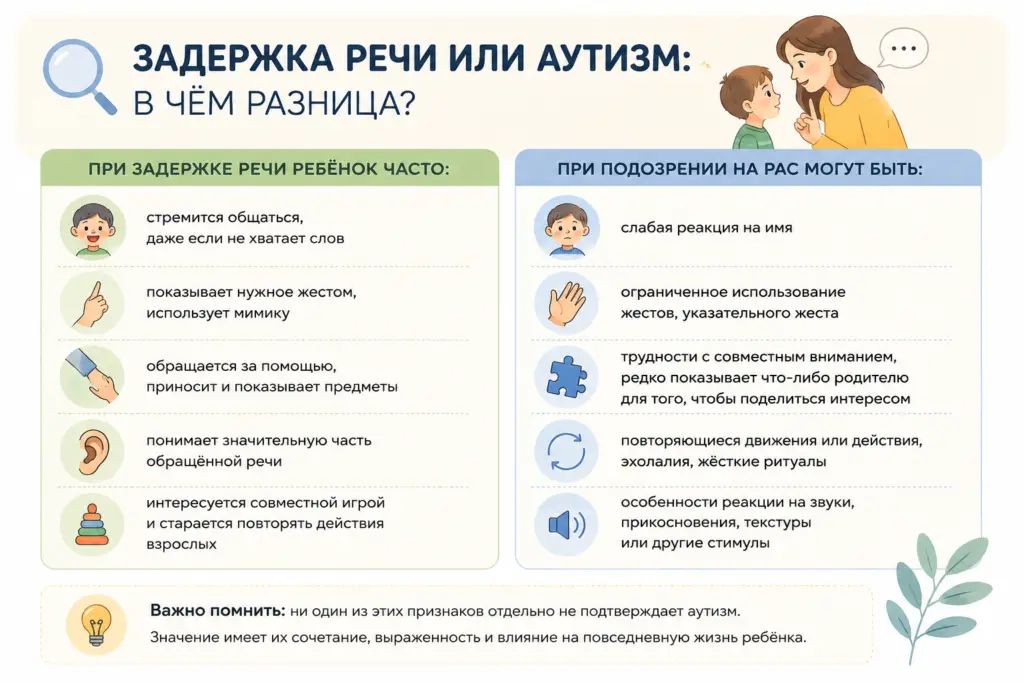
With predominantly speech delay, the child often:
- strives to communicate, even if he lacks words;
- shows the required gesture;
- uses facial expressions;
- asks for help;
- brings and shows interesting objects to an adult;
- reacts to the emotions of loved ones;
- tries to repeat the actions of adults;
- understands a significant part of the speech addressed to him;
- is interested in playing together.
If ASD is suspected, along with speech delay, the following may be encountered:
- weak response to name;
- limited use of gestures;
- absence or rare use of the pointing gesture;
- difficulties with joint attention;
- a child rarely shows a parent something simply to share an interest;
- difficulties in including an adult in the game;
- echolalia - repetition of heard words or phrases;
- repetitive movements or actions;
- pronounced attachment to certain rituals;
- difficulty changing the usual routine;
- very narrow or intense interests;
- unusual reactions to sounds, smells, touch, textures, or other sensory stimuli.
⚠️ Important: none of the listed signs alone confirm autism.
What matters is their combination, severity, stability and impact on the child’s daily life.
💬 The child doesn't speak, but understands everything. Is this autism?
Not necessarily.
Sometimes a child's active speech is more delayed: he understands spoken words and instructions much better than he is able to express his own thoughts.
Therefore, even if you are concerned about the question “the child does not speak, this is autism” , it is important to evaluate not only the ability to pronounce words.
Look at:
- does the child follow requests without gesture prompts;
- does it show items on request;
- does he understand simple questions;
- does he use gestures;
- does he address his parents;
- does he try to involve an adult in the game;
- can he ask for help?
- does he share his emotions and interests?
For example, a child may not speak, but take his mother's hand, look at her, point at a banana and make it clear what he wants.
This is also communication.
It is important to evaluate the entire system of a child’s interaction with others, and not just the presence or absence of words.
🧩 The child speaks - does that mean there can't be autism?
This is also a common misconception.
A child with ASD may have a fairly large vocabulary and even well-developed grammatical speech.
Difficulties may manifest themselves not in the number of words, but in how exactly the child uses speech in communication.
For example, a child may:
- talk a lot about your interests, but hardly maintain a dialogue;
- repeating a question instead of answering;
- quote cartoons or previously heard phrases;
- speak in cliched constructions;
- find it difficult to start a conversation on your own;
- not noticing whether the interlocutor is interested;
- have difficulty transferring speech skills to new situations.
Therefore, the presence of speech in itself does not allow us to confirm or exclude ASD.
⏰ At what age should a lack of speech be a cause for concern?
The pace of development in children does vary. However, there are age-specific guidelines that can help you understand when it's time to discuss development with a specialist.
About:
- к 15 months many children try to pronounce their first words other than “mom” and “dad”;
- к 18 months the child usually uses a few simple words;
- к 2 years combinations of at least two words appear;
- к 2,5 years the vocabulary gradually expands and more diverse phrases appear;
- к 3 years The child is usually able to participate in at least a short dialogue.
📌 These guidelines are not used for self-diagnosis.
Development must be assessed comprehensively.
However, if a child is two or three years old, has virtually no speech, and parents repeatedly ask the question, “If the child doesn’t speak, is it autism?” , it’s wiser not to wait another year, but to get a professional development assessment.
🚨 It is especially important to pay attention to the loss of already acquired skills
A separate situation is developmental regression.
For example, a child:
- spoke a few words and then stopped;
- Previously he responded to his name, but now he hardly reacts;
- Previously, he actively interacted with his parents, but then began to do so much less often;
- stopped using gestures;
- lost some everyday or play skills;
- became less interested in communication.
The loss of previously acquired speech, social, or other skills is a reason not to delay a professional assessment of the child's condition.
🧠 Why might a child not speak?
Lack of speech is not always associated with autism.
Delayed speech development can accompany various conditions and developmental characteristics.
Among the possible causes, experts consider:
- hearing impairment;
- delayed speech or language development;
- general developmental delay;
- features of the development of the nervous system;
- speech motor skills difficulties;
- autism spectrum disorder;
- other conditions affecting development and communication.
This is why it is impossible to make a diagnosis based on just one complaint : “the child does not speak, this is autism.”
The specialist's task is not to give the child a specific name for the condition as quickly as possible, but to understand his individual development profile and determine what kind of help is needed right now.
👂 Why is it important to have your hearing checked if you have a speech delay?
Sometimes parents are sure:
"He definitely hears everything. As soon as he turns on his favorite cartoon, he comes running."
But reactions to music, television, or everyday sounds do not always allow us to fully assess a child’s ability to perceive human speech.
For speech development, it is important not only to hear sounds, but to distinguish speech signals well.
Therefore, hearing testing may be one part of the evaluation of a child with severe speech delay.
🏠 What can parents pay attention to at home?
Instead of constantly asking:
"Tell me, Mom."
"Repeat."
"What is it called?"
Try observing your child's spontaneous communication for a few days.
1. Does the child respond to his name?
Notice if he responds to his name in a variety of situations, not just when there are no distractions around.
2. Is there a pointing gesture?
Does the child point to the object he wants to receive?
More importantly, is he showing you something simply to share an interest with you?
For example: I saw a plane, pointed at it and looked at my mother.
3. Does the child share emotions?
When something interesting or unusual happens, does your child look at you as if checking your reaction?
4. How does he ask?
Uses:
- word;
- sound;
- gesture;
- sight;
- pointing gesture;
- independently leads an adult to the desired object?
5. Does he understand the speech addressed to him?
Try simple requests:
"Bring the shoes."
"Put the car on the table."
"Give the ball to daddy."
It is important to understand whether the child is fulfilling the request precisely because he understood the words, and not because the adult additionally pointed with his hand where to go.
6. How does the child play?
Does he use toys for their intended purpose?
For example:
- rolls the car;
- feeds the doll;
- puts the bear to bed;
- builds a tower;
- repeats the adult's play actions.
7. Does he seek interaction with you?
Does it bring anything to show?
Is it suitable just for communication?
Does he ask for your help?
Does he want to share the joy?
💡 The answers to these questions often give a parent more information than a simple word count.
⌛ "We were told to wait up to three years."
If parents notice a significant developmental delay, the “just wait it out” strategy is not always justified.
A professional assessment does not necessarily mean that the child will be diagnosed.
Her task is to understand:
- is development age appropriate;
- what skills have already been developed;
- what skills are delayed;
- Are there difficulties only with speech?
- whether understanding, communication, play or interaction are affected;
- What kind of support does the child need now?
If the question “the child does not speak, this is autism” is already causing serious concern for the family, a consultation with a specialist can be much more useful than waiting a few more months.
🗣 Why aren't pronunciation-only lessons sometimes enough?
Parents naturally want to hear speech first.
"Mother".
"Dad".
"Give it."
"Want".
But before speech becomes a fully-fledged communication tool, a whole complex of skills is formed:
person → attention → understanding → intention to address → communication → speech.
If the child:
- hardly addresses a person;
- rarely uses gestures;
- does not try to share interest;
- poorly understands spoken language;
- does not know how to ask for help;
- does not take initiative in communication,
then working only on the pronunciation of individual words may not be enough.
It is important to evaluate the child as a whole, and not just his speech apparatus.
✅ What to do if a child does not speak?
If the absence or significant delay of speech is a concern, there are steps you can take.
Step 1: Don't self-diagnose
Neither an online test, nor any single symptom, nor the absence of speech alone can diagnose autism.
Step 2: Assess development comprehensively
It is important to consider:
- speech understanding;
- gestures;
- eye contact;
- social interaction;
- game;
- behavior;
- sensory reactions;
- household skills;
- dynamics of development.
Step 3: Have your hearing checked if necessary
Especially if the child does not always respond to spoken language or name.
Step 4: Look beyond the appearance of words
Before active speech, very important skills can change:
- understanding;
- attention to the person;
- ability to carry out requests;
- cooperative play;
- initiative appeal;
- use of gestures;
- desire to interact.
This is the foundation necessary for further communication.
💙 How do LTP® specialists view speech impairment?
In the LTP® method, speech is not viewed as a completely isolated skill.
When parents say:
"We are only concerned with speech "
Experts additionally analyze how the child:
- understands the address;
- interacts with parents;
- asks;
- shows initiative;
- maintains joint attention;
- plays;
- reacts to others;
- uses available means of communication;
- copes with everyday situations.
Therefore, the question “if the child does not speak, this means autism” is only a starting point for a specialist.
It is important to see the big picture of development.
The goal is not simply to increase the number of spoken words, but to develop meaningful communication that the child is able to use in everyday life.
The LTP® method does not replace medical diagnostics and is not used for self-diagnosis of ASD.
❤️ What exactly is happening to your child?
Two children of the same age without speech can have completely different developmental patterns.
One child actively uses gestures, understands parents, constantly addresses them and tries to interact.
Another may use almost no gestures, have difficulty understanding spoken language, rarely address adults, and prefer repetitive actions.
Therefore, there is no single answer to the question “if a child does not speak, this is autism” without familiarity with the specific situation.
If you would like to learn more about your child's development, you can fill out a form and schedule a free online consultation with an LTP® specialist.
During the consultation, a specialist will get to know your situation, ask clarifying questions, and help you understand which aspects of your child's development are especially important to focus on now.
Frequently Asked Questions (FAQs)
The child does not speak, is this autism?
Not necessarily. Lack of speech alone is not sufficient grounds for diagnosing ASD. Social communication, speech comprehension, gestures, interaction, play, and other developmental aspects must be assessed.
If a child doesn’t speak at 2 years old, is this autism?
No. However, if, along with the lack of speech, the child does not use pointing gestures, has poor understanding of spoken language, rarely addresses adults, or has other developmental issues, it is advisable to discuss the situation with a specialist.
How to distinguish speech delay from autism?
With predominantly speech delays, children often retain a desire to communicate and use gaze, gestures, facial expressions, and other methods to do so. With ASD, these differences can affect a broader range of social communication skills and behavior.
It is impossible to independently make or exclude a diagnosis based on these symptoms.
Can a child with autism speak well?
Yes. Having a large vocabulary does not rule out ASD. Difficulties may manifest in the ability to maintain a dialogue, understand social context, and use language to interact with others.
If a child understands everything but does not speak, is it necessary to contact a specialist?
If active speech is significantly behind age expectations, developmental assessment may be useful even with good speech comprehension.
Do you need to wait until three years?
If the delay is significant or parents notice additional developmental differences, it's not necessary to simply wait until a certain age. A professional assessment will help understand the current situation much earlier.
📚 Useful articles on the topic


This material is for informational purposes only and is not intended for self-diagnosis. If you have any questions about your child's development, please consult a qualified specialist.