🌱 Does a child with autism eat dirt, sand, or inedible objects? Why does this happen and how does the LTP® method work?
Many parents of children with autism (ASD) , developmental delay , speech delay , or delayed speech development (DSD) are faced with an unusual situation: the child begins to eat dirt, sand, chalk, paper, paint, hair, fabric, or other inedible objects.
This becomes a source of great concern for parents. Questions arise:
- Why does the child eat dirt?
- Is this related to autism?
- How dangerous is it?
- What should parents do?
- Is it possible to help the child?
In fact, this problem is much more common than it seems, especially in children with developmental disabilities.
🧩 What is pica?
When a child regularly eats items that are not food, the condition is called pica.
The name comes from the Latin word Pica pica , meaning magpie, a bird known for its habit of picking up a wide variety of objects.
With pica, a child can eat:
- land;
- sand;
- a piece of chalk;
- paper;
- cardboard;
- cloth;
- hair;
- plastic;
- Styrofoam;
- paint;
- ice;
- soap;
- sponges;
- wood and other inedible materials.
This behavior can be observed either periodically or daily.
🤔 Why does a child with autism eat dirt?
It is important to understand that most often this is not bad behavior or a desire to do something specifically to spite parents.
Pica is usually a manifestation of deeper physiological or sensory issues.
The most common reasons:
Sensory features
Many children with ASD experience a constant need to experience certain sensations through the oral cavity.
They may like:
- sand texture;
- feeling of the earth;
- the crunch of chalk;
- paper density;
- other unusual sensations.
In this case, eating inedible objects becomes a way of receiving sensory stimulation.
Possible vitamin and mineral deficiencies
In some cases, pica may be accompanied by a deficiency:
- gland;
- zinc;
- magnesium;
- other vitamins and microelements.
Therefore, with such behavior, it is important to look not only for the external manifestation of the problem, but also for its possible causes.
Gastrointestinal disorders
Many children with ASD experience the following at the same time:
- pronounced selectivity in food;
- limited diet;
- digestive disorders;
- bowel dysfunction;
- insufficient intake or absorption of nutrients.
These factors may exacerbate various forms of unusual eating behavior.
High stress on the nervous system
Sometimes a child starts eating soil during:
- severe anxiety;
- emotional overload;
- sensory fatigue;
- stressful situations.
In such cases, such behavior can serve as a kind of self-regulation.
A combination of several factors
In practice, there is rarely only one reason.
Most often, the following are present simultaneously:
- sensory features;
- limited nutrition;
- digestive disorders;
- increased stress on the nervous system.
This is why there is no universal solution that suits every child.
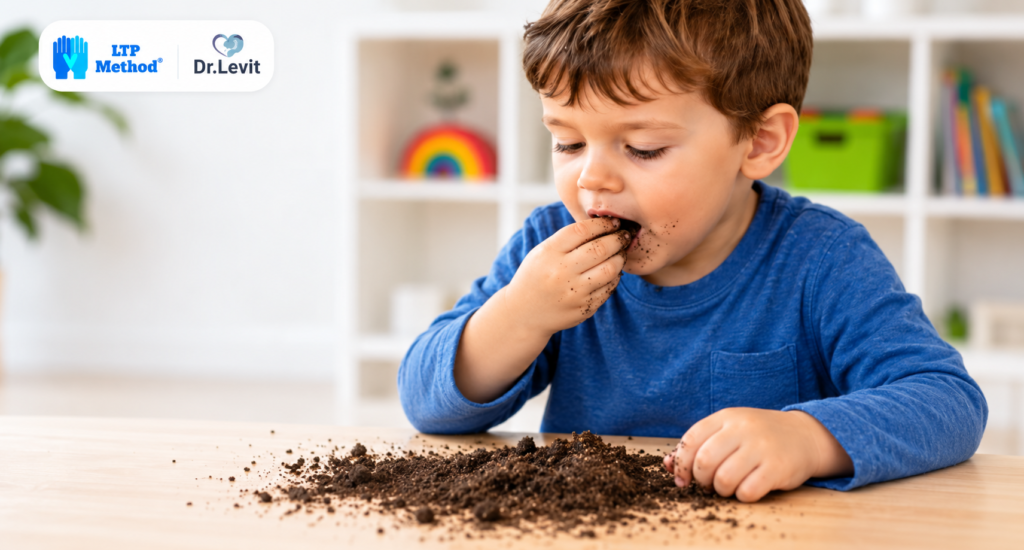
⚠️ Is it dangerous for a child to eat soil?
Yes.
Eating soil and other inedible objects can lead to serious consequences.
Possible risks include:
- intestinal infections;
- parasitic infestation;
- exposure to toxic substances;
- chemical poisoning;
- damage to the stomach and intestines;
- intestinal obstruction;
- risk of choking when swallowing large objects.
Therefore, such behavior cannot be ignored.
Why don't bans usually help?
Many parents try to constantly forbid their child from touching soil, scold him, or try to remove all dangerous objects from sight.
However, if the cause of this behavior is not addressed, the problem often persists.
Sometimes the child simply starts looking for another inedible object.
Therefore, it is important to work not only with the symptom itself, but also with what lies behind it.
💙 How does the LTP® method help children who eat dirt?
The LTP® (Levit Therapeutic Principles) method looks at the child holistically.
We don't just fight the symptom.
Our task is to create conditions under which the child’s body begins to function more stably.
1. Power supply stabilization
Work begins with restoring a complete therapeutic diet.
Gradually, the diet expands, and the child begins to receive a sufficient amount of proteins, healthy fats, carbohydrates, vitamins, and microelements.
This helps reduce the risk of nutritional deficiencies and create the basis for the normal functioning of the body.
2. Working with the gastrointestinal tract
The LTP method places great emphasis on the condition of the digestive system.
The work is aimed at:
- improve digestion;
- normalization of bowel function;
- stabilization of stool;
- support for the processes of nutrient absorption.
When the gastrointestinal tract begins to function more efficiently, the body receives more of the necessary resources.
3. Individual vitamin therapy
After nutrition has stabilized, an individual nutritional support program is selected.
Its purpose is to replenish possible vitamin and microelement deficiencies, support the functioning of the nervous system, and create conditions for the normal development of the child.
4. Reducing nervous system overload
One of the important objectives of the method is to reduce the physiological overload of the body.
As a child begins to sleep better, becomes calmer, more comfortable with their environment, and receives adequate nutrition, many children gradually experience a decrease in various forms of unusual eating behavior, including the desire to eat inedible items.
5. Parent education
The LTP method is parent training.
The family receives step-by-step recommendations on nutrition, daily routine, introducing new products, and specialist support throughout the program.
This comprehensive approach allows us to work not only with the manifestations of the problem, but also with the possible causes of its occurrence.
Important to understand
The LTP® Method is not a treatment for pica as a separate diagnosis and does not promise that this behavior will disappear in every child.
However, with comprehensive work on the physiological state of the body, nutrition, the gastrointestinal tract, replenishing possible deficiencies and reducing the overload of the nervous system, many families note a reduction in various forms of unusual eating behavior.
📞 When should you seek advice?
Do not delay contacting specialists if your child:
- regularly eats soil, sand or chalk;
- swallows inedible objects;
- tries to eat paper, fabric or plastic;
- has a pronounced selectivity in nutrition;
- often experiences digestive problems;
- has a diagnosis ASD, ZPR, ZPRR or ZRR.
The sooner you can understand the reasons for this behavior and begin comprehensive work, the higher the likelihood of achieving positive changes.
💙 Sign up for a free consultation
If your child eats dirt, sand, chalk, or other inedible objects, Dr. Levit Clinic specialists can help you understand the possible causes of this behavior and advise you on whether the LTP® method is right for your child.
During a free consultation you will be able to:
- discuss your child's specific symptoms;
- get recommendations on next steps;
- find out how the LTP® program works;
- Ask a specialist all your questions.
Request a free consultation, and we'll help you determine where to start in your specific situation.
❓ Frequently Asked Questions (FAQ)
Why does a child with autism eat dirt?
The causes may vary: sensory characteristics, a limited diet, possible vitamin and mineral deficiencies, gastrointestinal disorders, high stress on the nervous system, or a combination of several factors.
Is it dangerous for a child to eat soil?
Yes. This can increase the risk of intestinal infections, parasitic infestations, toxic substance ingestion, gastrointestinal damage, and other complications.
Should we simply forbid a child from eating soil?
No. Bans may temporarily stop the behavior, but if the underlying causes are not addressed, the problem often persists or manifests in a different form.
Can diet affect pica?
Yes. In some children, unusual eating behavior may be related to a limited diet, impaired nutrient absorption, and other physiological factors. This is why it's important to assess the child's condition comprehensively.
How does the LTP® method help children with pica?
The LTP® method is aimed not at symptom suppression, but at comprehensively addressing the child's physiology. The program includes nutritional stabilization, gastrointestinal support, individualized vitamin therapy, reducing nervous system stress, and parental education. As the overall health of the child improves, many children experience a reduction in various unusual eating behaviors.
Is it possible to take the LTP® program if a child is already studying with other specialists?
Yes. The LTP® method is a parent training program and can be used in conjunction with observation by a treating physician and other types of child support.