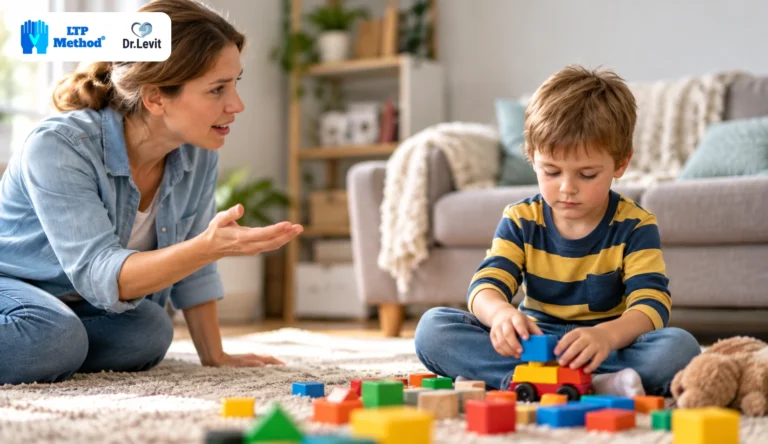
Speech development disorder is a disorder caused by underdevelopment of the speech centers of the cerebral cortex, leading to general speech underdevelopment. It can be congenital or acquired.
Speech development in children does not occur spontaneously. Its development begins from the moment a child is born.
Children from 0 to 6 months:
– They react to sounds
– They are afraid of loud sounds
– They watch the face of the person talking to them.
– They recognize their voice and parents.
– They respond to emotions.
– They make sounds in the form of cooing and squealing to attract attention and express their emotions.
Children from 6 to 12 months:
– They babble in the form of a sequence of sounds.
– They respond to emotions with emotions.
– They begin to understand simple words and gestures.
– They already recognize the objects around them.
Children from 12 to 18 months:
– They begin to understand many more words.
- They answer simple questions.
– They follow simple instructions.
– They pronounce up to 20 separate words.
– They copy adults, cartoon characters.
– They play a simple role-playing game.

Speech development disorder or when should you start sounding the alarm?
Speech developmental disorders can begin to occur as early as 0 to 6 months of age, and become especially noticeable by the child's first year of life, for example:
– The child does not respond to his name, completely or partially.
– The first words do not appear or the vocabulary is limited to a small number of words.
– There is no imitation of adults, animals, or cartoon characters.
– The baby does not recognize the emotions of adults and does not show emotions in response.
It is at the moment when you notice that something is wrong that you can seek help from specialists.
Unfortunately, when a speech development disorder is discovered, parents listen to "kind" people or specialists who advise waiting until the magical age of 3 years.
Speech development disorders in their pure form are virtually nonexistent these days. A partial or complete lack of speech can be a symptom of a number of other problems. Waiting until age three is simply a waste of time and will allow the problem to worsen.
Causes of speech development disorders in children with autism
It is important to understand that the causes of speech development disorders may be hidden by a whole complex of psycho-emotional and physiological disorders that prevent a child from initiating and developing full speech.
For example, a child has not only a speech development disorder, but also:
– no eye contact;
- no reaction to your name;
– vocabulary (if any) is based only on basic needs (eating, sleeping, cartoons);
– no understanding of simple instructions;
– there is sleep disturbance and food selectivity;
– lack of self-care skills (for example, does not go to the toilet on their own);
- and much more.
Parents, however, focus solely on their child's speech development, believing that the entire problem lies in the complete or partial absence of speech. And if they focus on solving this problem, everything else will "go away on its own." Unfortunately, this is not the case.
Firstly, when sending your child to a speech therapist/specialist/ABA therapy, or all of them at once, you must understand that when several specialists are simultaneously working on the child's correctional work without interacting with each other, it is impossible to say that they are pursuing only one goal.
As a rule, everyone focuses on what they consider necessary.
Secondly, these types of activities emphasize logic: matching color, shape, size, picture to picture, and so on. Children, regardless of the severity of their learning disabilities, have little difficulty following these types of instructions, as their logical thinking is intact. They can easily construct logical chains and understand what follows what.
A speech development disorder is simply a consequence of a number of psycho-emotional and physiological problems, without which it is impossible to achieve full speech development or its positive development.

Speech delay or autism?
Speech development disorders most often hide a number of conditions such as mental retardation with ASD, ASD and AUTISM.
Speech development is a gradual and multifaceted process that is linked to many factors. One of them is the ability to form images of objects in one's mind.
How does this happen?
When a child sees an object, all of his senses are activated in order to fully examine the object and then form an image of it in his mind.
For example, a child sees a cat, perceives its color, smell, and body parts; when touching it, they feel the softness of its fur. This entire set of sensations is imprinted in the child's mind regarding the cat.
In a pure speech development disorder, an image is recorded in the mind, but the child has difficulty reproducing this image through speech. Children with autism, on the other hand, experience impairments in perception and information processing, which prevents them from recording this image. The lack of perception and recording of the image leads to speech development disorders.
This lack of perception and recording of images in the mind can be compared to the situation when you hear a foreign language but cannot understand it. This is precisely what hinders speech development.
The reason why children with autism cannot record images of objects in their consciousness is that the child is not in contact with the outside world, but within himself.
Speech development should begin with restoring the child’s ability to:
– It’s elementary to look into the eyes
– Give attention to the interlocutor
– Concentration of attention on the interlocutor
– Interest in the interlocutor
Only then will the child be able to fully engage with the world around him, perceive the speech of others, communicate, and consciously use words in his own speech.
The unique LTP® method: how to eliminate the cause of speech delays
The unique LTP® method by Israeli specialist Michael Levitt helps restore lost brain abilities such as the ability to communicate and connect.
This ability allows the child to express his needs and desires and contributes to the formation of necessary skills and abilities.
Moreover, the ability to communicate is the foundation for further speech development. After all, if a child is disconnected from reality and unable to pay attention to the outside world, how will they ever master full-fledged speech?
The unique LTP® method offers a comprehensive program for the rehabilitation of children with speech disorders.
Power stabilization
This step involves a two-week program that is guaranteed to help introduce a balanced diet into the child's diet, consisting only of healthy, nutritious foods rich in various micronutrients and fiber.
Vitamin therapy
A personalized micronutrient program supports the body of a child with autism spectrum disorder not only by replenishing nutrient deficiencies but also by helping the body acquire additional resources to restore lost abilities.
LTP® Recovery Exercises
This approach encourages children to connect with the world around them and improves relationships between children and their parents. Children develop the ability to interact consciously and under stress, as well as the ability to perceive information and communicate effectively.
Michael Levit's unique LTP® method aims to restore a child's ability to communicate, improve their level of communication and interaction with parents and the world around them.