Cartoons and autism: the main question that worries parents
Cartoons and autism are one of the most popular search queries among parents of children with autism spectrum disorder (ASD).
After a diagnosis, many people begin to search for the cause of what happened and ask similar questions:
- Can autism be caused by cartoons?
- Is it true that tablets cause ASD?
- If you remove the screen completely, will the child start talking?
- Have we harmed our child by turning on cartoons too often?
These concerns are understandable. However, it's important to distinguish between common myths and scientific facts.
In this article, we'll explore whether there's a link between cartoons and autism, what modern research says, and why experts are increasingly turning their attention to completely different causes.
Do cartoons cause autism?
The short answer is no.
To date, there are no studies that have proven that cartoons and autism are directly related.
Autism spectrum disorder is a physiological condition in which the normal functioning of various bodily systems is disrupted. These changes can affect the nervous system, digestive tract, metabolism, information perception, and interaction with the outside world.
This is why the claim that cartoons cause autism has no scientific basis.
But this doesn't mean that screen time is safe in any amount.
Why does the topic of "cartoons and autism" still cause so much controversy?
Although cartoons do not cause ASD, excessive screen time can indeed impact a child's development.
When a child spends hours in front of a screen, there is less time for what really develops the brain:
🗣️ live communication;
👀 eye contact;
🤝 joint games;
😊 emotional exchange;
💬 development of speech comprehension;
❤️ interaction with loved ones.
This is why experts recommend maintaining a healthy balance between using gadgets and face-to-face communication.
What does research say about the link between cartoons and autism?
Modern research shows that excessive screen time can be accompanied by:
✅ delayed speech development;
✅ decreased communication with parents;
✅ deterioration of concentration;
✅ sleep disturbance;
✅ increased irritability;
✅ reducing the time of active play.
However, it is important to understand one fundamental thing.
Research does not show that cartoons and autism have a cause and effect relationship.
They only show that large amounts of screen time can exacerbate existing developmental issues in children.
Cartoons and Autism: Myths and Facts
| ❌ Myth | ✅ Fact |
|---|---|
| Cartoons cause autism | To date, this has not been confirmed by scientific research. |
| If you remove the TV, the child will immediately start talking. | A comprehensive approach is needed for speech development |
| The tablet replaces educational activities | No screen can replace live communication. |
| Educational cartoons accelerate development | The basis of development remains interaction with adults |
| The parents are to blame for everything | The causes of ASD are much more complex and are related to the physiological processes of the body. |
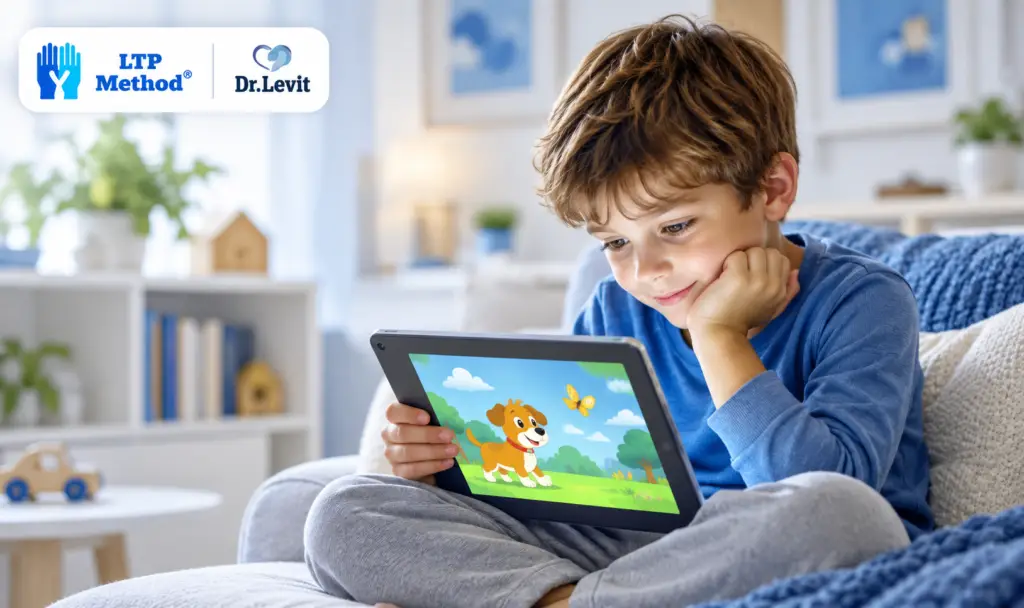
Why might a child with ASD constantly watch cartoons?
Many children with autism enjoy predictable environments.
Cartoons provide exactly this:
🎨 bright images;
🔁 repeating scenes;
🎵 identical melodies;
📺 no need to engage in dialogue;
😊 minimum unexpected events.
This is why a child may be much more comfortable being in front of a screen than interacting with the outside world.
When do cartoons really start to hinder development?
There is a reason to pay attention if the child:
📌 watches cartoons for hours;
📌 gets irritated when the TV is turned off;
📌 stopped being interested in toys;
📌 prefers screen to people;
📌 has trouble falling asleep;
📌 does not strive to play together.
This does not mean that the problem lies with cartoons.
More often than not, they become just a way for the child to move into the most comfortable and predictable environment possible.
Why isn't it enough to just remove cartoons?
Many parents say:
"We removed the TV completely, but there was no change."
This is not surprising.
If the child still has:
🥗 pronounced selectivity in nutrition;
😴 sleep disorders;
🦠 digestive problems;
⚡ high physiological overload of the body;
🧠 deficiency of essential nutrients,
then giving up cartoons in itself will not eliminate the reasons that hinder the child’s development.
How does the LTP® method help a child switch from the screen to real life?
In the LTP® method , we do not start by banning cartoons.
We begin by eliminating factors that may interfere with the child's interaction with the world around him.
The first stage is aimed at stabilizing the physiological state of the body:
🥩 expansion of diet;
🥦 replenishment of nutrients;
💧 improving the functioning of the gastrointestinal tract;
🌙 sleep restoration;
⚡ increased energy levels;
🧠 Reduction of constant overload of the body.
This is why parents often notice the first changes even before new words appear.
Child:
😊 Wakes up easier in the morning;
👀 looks into the eyes more often;
🤝 starts looking for contact;
🎲 shows interest in toys;
❤️ becomes emotionally calmer;
💬 responds more often to requests.
And only after this does it become significantly easier to develop understanding of speech, communication and new skills.
This approach helps to work not with the symptom, but with the state of the child’s body as a whole.
Conclusion: Cartoons and autism are not the cause, but only one of the environmental factors
🎯 Cartoons and autism have no proven cause-and-effect relationship.
However, excessive screen time may actually exacerbate existing developmental difficulties by reducing face-to-face interaction, shared play, and social activity.
If a child has difficulty understanding spoken language, does not speak, prefers screens to people, has pronounced food selectivity, sleep disturbances, or digestive problems, it is important to look for the causes of this condition, not the culprit.
This is the basis for the comprehensive approach of the LTP® method.
Sign up for a free consultation
If you notice that your child:
✅ does not speak or speaks little;
✅ has poor understanding of spoken language;
✅ constantly requires a tablet or TV;
✅ has a selective diet;
✅ sleeps poorly;
✅ avoids communication,
Sign up for a free consultation with LTP® method specialists.
During the consultation, we will thoroughly examine your child's situation, answer questions, and advise you on the best way to begin.
👉 Submit a request now and receive personalized recommendations.
FAQ
Can autism be caused by cartoons?
No. Modern scientific research does not confirm a causal relationship between cartoons and autism .
Should cartoons be completely banned for children with ASD?
Usually no. It's important to maintain reasonable limits and devote more time to face-to-face interactions, games, and shared activities.
Why does a child with autism constantly ask for a tablet?
The screen creates a predictable and comfortable environment. But it's important to understand why the child avoids interacting with the outside world.
Will giving up cartoons help you get your speech going?
No. Giving up screens alone does not eliminate the physiological factors that can interfere with speech and communication development.
How does LTP® work begin?
The LTP® method begins with stabilizing the body's physiological state: normalizing nutrition, improving sleep, gastrointestinal function, and replenishing essential nutrients. As the child begins to feel better, they experience more energy, interest in the world around them, and a desire to interact with others.
📚 Read also
If your child prefers cartoons to face-to-face interaction, or you notice other developmental differences, we also recommend reading:
💬 Speech delay in children
What is important to consider if a child speaks little, does not use speech to communicate, or has difficulty understanding spoken language.
🧩 Signs of autism in children
What features of communication, behavior, speech and interaction require parental attention.
🌙 Sleep disturbances in children with ASD
Why a child may have difficulty falling asleep and waking up at night, and what parents should pay attention to.