Lev Isakovich Levit is the founder of the Dr. Levit Clinic, operating in Israel since 1996, and the inventor of the craniocerebral stimulation method. For many years, one of the main focuses of his practice has been working with children with mental, speech, and psychophysical developmental delays, autism spectrum disorders, and other developmental disabilities.
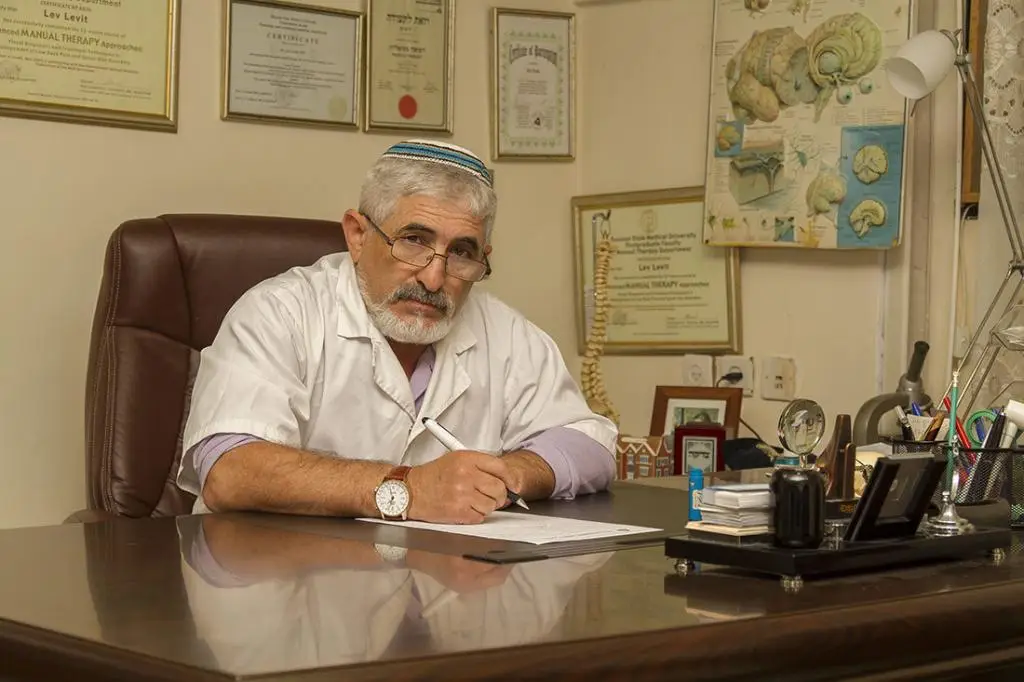
"Practice is the criterion of truth" —this is a phrase Lev Isakovich often uses when discussing his work. For him, practical experience and observation of children's condition have always played an important role in the development of his approach.
In this interview, the doctor discusses the difficulties parents face when they seek treatment at the clinic, how developmental delays can differ from regressive conditions, how he explains the principles of cranial therapy, and why results with different children can vary.
How do you start a conversation with parents who come to the clinic?
First of all, I try to understand what the child’s difficulties are.
Parents often come to us with a specific problem. For example, a mother says her three-year-old son doesn't speak and has a speech delay.
But during a conversation, it may become clear that the child not only doesn't speak, but also has difficulty understanding spoken language, doesn't play with peers, avoids eye contact, and exhibits frequent tantrums or unusual behavior patterns.
Then we understand that we are no longer talking about just a speech delay, but about a broader range of difficulties, including autistic manifestations.
Children with developmental delays may also have difficulty understanding. For example, a child may be able to follow a simple command like "give" or "put it down," but may have difficulty understanding instructions that involve several sequential actions.
In addition, when developmental delays occur, the delay can often be noticed in the first months or years of life.
Do children with autistic traits develop differently?
In some cases, yes.
It happens that up to one, one and a half, or two years of age, a child develops in accordance with his age, and then parents begin to notice regression.
The child may stop using words they used to speak, have difficulty understanding spoken language, and make less eye contact. Hyperactivity, stereotypical repetitive movements, and other autistic behaviors may develop.
In such cases, specialists may talk about a regressive course of autism.
Does regressive autism occur suddenly, without any reason?
In my practice, I always try to reconstruct in detail, together with the parents, the chain of events that preceded the regression.
Parents sometimes associate the onset of changes with the period after vaccination: they report prolonged crying, fever, changes in behavior, or other reactions, after which they began to notice regression.
In other cases, it is much more difficult to isolate one specific event.
In my opinion, it is necessary to consider a combination of factors: the characteristics of pregnancy and childbirth, possible birth injuries, past illnesses, viral load, the body's reaction to vaccination, and other circumstances.
When should parents worry about developmental delays?
We need to look not at one individual skill, but at the child’s development as a whole.
If a child does not yet speak, but communicates well with others, understands spoken language, is able to concentrate, plays in an age-appropriate manner, and continues to acquire new skills, late speech alone does not yet provide a complete picture of his development.
It’s a completely different situation when a child was developing, acquiring skills, and then development stopped or regression began.
If a child spoke 10-15 words and then they gradually disappeared, this cannot be ignored.
If, at the same time, he loses concentration, communication changes, unprovoked crying appears, pronounced outbursts of aggression or other noticeable changes in behavior appear, this is a reason to contact a specialist and sort out what is happening.
Cranial therapy and the original approach of Lev Levit
Some parents hope to come to Israel for a few weeks and immediately solve all their child's problems. Is that how it works?
No.
Cranial therapy is a consistent process that in some cases can be quite lengthy.
When parents ask me if I can guarantee a certain result in advance, I always answer that such guarantees cannot be given.
Every child is an individual.
I can draw on years of practical experience and observation of the children I have worked with, but it is impossible to determine in advance exactly how quickly a particular child will respond to therapy and how pronounced the changes will be.
Why do some children maintain changes after the course, while others may experience regression?
Each child's reaction is individual.
In some children, changes become noticeable during the first sessions and continue.
Others experience good dynamics after the course, but after some time there may be a rollback, after which development continues again.
It also happens that parents begin to see noticeable changes not immediately, but several months after the first course.
This is why it is impossible to evaluate all children according to the same scenario.
Do you work with children with genetic diseases?
Yes, but here it is especially important to understand the limits of the possibilities of therapy.
Genetic pathology cannot be eliminated.
The goal of treatment in such cases is not to change the genetic disease itself, but to try to improve the child's overall condition and support those functions that can be influenced.
In my practice, I have observed children with Down syndrome, Rett syndrome, and other genetic disorders and have seen changes in specific functions, such as concentration, activity, and speech skills.
At the same time, the underlying genetic disease, of course, remains.
For someone unfamiliar with cranial therapy, it simply looks like touching the head and body. Is it really possible to feel cranial rhythm with your fingers? Are there devices to measure it?
Cranial rhythm is monitored by instruments. However, there are no devices capable of delivering the therapy itself.
The specialist detects the cranial rhythm, determines its disturbances and the possible cause of the changes.
After this, with very soft and subtle movements, he works to restore and regulate the cranial rhythm.
To understand how a cranial therapist works, it is necessary to have at least a basic knowledge of osteopathy and a deep understanding of human anatomy and physiology.
How brain function is related to child development
Why might a child initially experience improvement after a course of cranial therapy, and then experience a relapse?
In this case we are working with the brain.
Brain development is linked to the development of neurons. Neurons connect to each other in circuits and transmit impulses from one area of the brain to another.
The brain's nervous system consists of tens of billions of neurons. Each neuron has numerous branches that interact with each other and form a unified system.
Normal development of a child is possible provided that the system of interaction of neural networks functions correctly, without failures.
If the process of formation and interaction of the neural network is disrupted, this can be accompanied by various developmental disorders - speech, mental and psychophysical, as well as autistic manifestations.
What, in your opinion, prevents neurons from connecting into a single system?
Among the factors I consider are birth trauma, oxygen starvation, asphyxia, and viral diseases.
Also in my practice, I associate certain cases with vaccination and the development of autoimmune processes.
I believe that autoimmune processes can lead to serious metabolic disorders, microelement and mineral metabolism, as well as biochemical disorders.
This is why our approach places great emphasis on metabolic processes and the overall health of the body.
Craniocerebral stimulation and metabolic processes
So, your original method of craniocerebral stimulation is aimed, among other things, at improving metabolic processes?
Yes. In our work, we focus on improving metabolic processes.
We associate this with changes in the movement of tissue fluid, lymph and cerebrospinal fluid.
During the course, many children's parents notice changes in physiological processes: the child may begin to sweat more, and urination may increase, despite the fact that the amount of liquid consumed remains the same.
The color and smell of urine may change, the amount of stool may increase, and the tendency to constipation may decrease.
We view these changes as part of the body's overall response to therapy.
In one of the videos on the clinic's website, a mother reports that after the treatment, her child's tooth enamel cleared of black plaque. Have you seen similar changes?
Yes.
In my practice, I have observed changes not only in the condition of tooth enamel, but also in the skin, hair and nails.
Roughened areas of skin may become softer. Hair structure and appearance change: it may become softer, shinier, and more manageable.
I associate such changes with the processes of metabolism and elimination of various substances from the body.
Similar changes in hair structure and growth can be observed with chelation, a procedure used to remove heavy metals from the body.
However, medicinal chelation can be accompanied by side effects, whereas in our practice we use an osteopathic approach.
Why do some patients experience rapid changes after a course of treatment and may not require repeat courses, while others require continued therapy?
There can be several reasons.
If the child is hardened and has a high resistance to colds, the effect of cranial therapy may be longer lasting.
Much depends on the presence of viruses and their activity, parasitic infestations, and the state of the thyroid gland.
The child may have metabolic disorders, including those associated with the absorption of gluten and casein.
In my practice, I also consider autoimmune processes that can occur after vaccination as one of the factors that can influence a child's condition and the duration of therapy.
Therefore, it is impossible to determine in advance how many courses a particular child will need. Each case is individual.
Dr. Levit Clinic today
Dr. Levit Clinic has been operating in Israel since 1996.
Over the past decades, the clinic's work areas have developed and expanded, but working with children with developmental delays and special needs remains one of its core areas.
Today, Lev Isakovich Levit personally conducts in-person consultations and craniocerebral therapy at a clinic in Israel.
At the same time, another direction of Dr. Levit Clinic is developing – the LTP Method® , based on systematic work with the child’s condition and development and training parents to work with the child in his natural, everyday environment.
Free initial consultation
If a child has delayed speech or psychophysical development, difficulties understanding spoken language, communication, behavior, nutrition, or other developmental issues, parents can schedule a free initial online consultation with a Dr. Levit Clinic specialist.
During the consultation, the specialist will thoroughly analyze the child's situation based on the parent's information, answer questions, and explain which areas of work may be relevant in a particular situation.
Interviewed by Anna Reznikov.