🧠 How to distinguish mental retardation from autism: 5 key differences that save time
More and more parents are wondering: how to distinguish developmental delay from autism in their child? These conditions may appear similar at first glance, especially at an early age. But behind the apparent silence or lack of response, different causes, approaches, and perspectives lie.
The distinction between mental retardation (MR) and autism spectrum disorder (ASD) is critical for providing appropriate support to a child. Today, we'll explain what behavioral, speech, and emotional characteristics to look for to quickly identify whether a delay is temporary or autism.
Why is it important to distinguish between mental retardation and autism?
The answer lies in how the child develops. Developmental delay is a temporary developmental delay, often overcome with intervention. Autism , on the other hand, is a different brain architecture, requiring completely different strategies and approaches.
If you miss the moment, you can either underestimate the need for early intervention or overload your child with unnecessary programs.
What is mental retardation (MR)?
Developmental delay (ZPR ) is a condition in which a child lags behind their peers in achieving age-appropriate standards. However, their intelligence may remain within the normal range.
Types of mental retardation:
Speech delay (SD)
Motor (motor)
Cognitive (mental)
Emotional-social
Such children, as a rule, seek contact , smile, hug, show emotions, but cannot clearly express themselves in words or actions.
What is autism (ASD)?
Autism is a neurodevelopmental disorder that affects perception of the world, communication, social skills and behavior.
The main signs of autism:
Lack of eye contact
Repetitive behavior (stims)
Unwillingness to interact
Speech delay and characteristics
Limited interests
A child with ASD often seems to be “in his own world ,” does not respond to his name, and does not seek support from an adult.
The symptoms are similar and it’s difficult to figure them out on your own?
Don't try to determine your child's condition solely based on online symptom lists. You can discuss your child's individual developmental picture with a specialist during a free consultation.
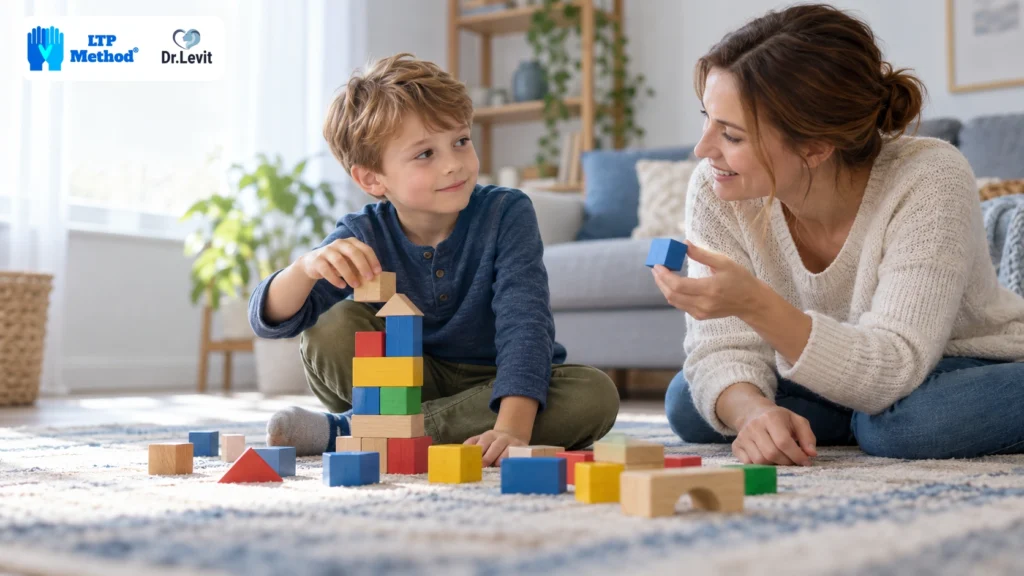
How to distinguish mental retardation from autism: behavioral markers
Contact with others
Mental retardation: the child reaches out to adults, smiles, shows emotions, but has difficulty expressing them.
Autism: no eye contact, no response to name, avoidance of tactile and visual interaction.
🔎 Sociability is one of the most reliable signs for understanding how to distinguish developmental delay from autism.
Speech and understanding
Mental retardation: the child speaks little, but tries to communicate, using gestures or facial expressions to explain his or her desires.
Autism: possible complete muteness or echolalia, lack of understanding of spoken language.
Behavior and reactions
Mental retardation: the child is active, can be impulsive, but flexible and teachable.
Autism: stereotypical behavior - clapping, spinning, running in circles, arranging objects in a row.
Play activities
Mental retardation: plays simple role-playing games, copies adults, builds a plot.
Autism: prefers manipulation of objects, avoids group games, interests are limited.
Emotional responsiveness
Mental retardation: the child is happy to see familiar people, reacts to intonations, shows fear or joy.
Autism: emotional “flatness”, the child does not distinguish the emotional states of others.
How to distinguish mental retardation from autism in a child under 3 years old?
Infancy and preschool age are the most difficult times for diagnosis. However:
In favor of ZPR:
The child responds to the name
Uses a pointing gesture
Searching with the eyes of an adult
In favor of autism:
Doesn't look into the eyes
It doesn't reach your hands
There is no response to external stimuli
Diagnostic methods: from observation to result
A diagnosis is never made based on a single symptom. To distinguish developmental delay from autism, a comprehensive examination is required:
Neurologist
Child psychiatrist
Speech therapist-defectologist
Psychologist
Methods (ADOS, M-CHAT-R/F)
Observation, surveys and game testing allow us to pinpoint the cause of the lag.
What to do if you are not sure?
Don't wait for them to "outgrow it." Early intervention at 2-3 years old is much more effective than late intervention at 6-7 years old.
Detoxification of the body
Emotional therapy
Work with parents
And most importantly, no medications or side effects.
Conclusion: How to distinguish mental retardation from autism and not miss the opportunity
To summarize: ZPR is a developmental delay, but along the "traditional" path. Autism is a different path. The following helps distinguish one from the other:
Contact
Speech
Behavior
Emotionality
Game
Early understanding is the key to a child's future.
📩 Don't know if your child has developmental delay or signs of ASD?
It can be difficult for parents to figure things out on their own.
My child speaks little - is this a speech delay or part of the overall picture of ASD?
Doesn't fulfill requests - doesn't understand or doesn't want to?
Does he play on his own - a character trait or interaction difficulties?
Doesn't point, doesn't always respond to name, repeats phrases, makes stimuli— how important is each of these signs?
And the most difficult thing is that one child can simultaneously have peculiarities of speech, understanding, behavior, nutrition, sleep, and communication.
Therefore, you should not try to make a diagnosis on your own based on one symptom or an online test.
At a free initial consultation with a Dr. Levit Clinic specialist , we can discuss your child's specific situation:
🔹 What developmental features are you observing now?
🔹 how the child understands addressed speech;
🔹 how he communicates and expresses his desires;
🔹 What difficulties are present in everyday life;
🔹 Where to start and is the LTP® program suitable for your child?
The sooner parents understand the specific difficulties their child is facing, the less time is spent chaotically trying to deal with individual symptoms.
Do you read the signs of developmental delay and autism and recognize your child in both?
It can be difficult to understand the overall picture based on individual symptoms. During a free consultation, a specialist will examine your child's development, speech comprehension, communication, and behavioral characteristics and suggest areas for further attention.
❓ Frequently asked questions
🧩 How to distinguish mental retardation from autism at home?
It's impossible to reliably differentiate developmental delay from ASD based on a single characteristic. It's important to look at the overall picture: does the child seek interaction, respond to their name, use gestures, understand spoken language, attempt to communicate independently, and how they play and react to others. A professional assessment is necessary for a diagnosis.
🔄 Is it possible to confuse mental retardation and autism?
Yes, especially at an early age, some symptoms can appear similar. For example, with both mental retardation and ASD, parents may notice speech delays, difficulties following instructions, or behavioral peculiarities. Therefore, it's impossible to draw conclusions based on just one symptom.
💬 How to differentiate mental retardation from autism based on speech?
It's important to look beyond the number of words. Pay attention to how the child uses the language they have : whether they speak independently, ask for words, respond to questions, use gestures and facial expressions, and understand spoken language. Echolalia—repetition of words and phrases heard—may also be present in ASD.
🧠 What's more important: a diagnosis or working with a child's difficulties?
Diagnosis is important, but parents also need to understand their child's specific challenges. Even children with the same diagnosis can vary greatly in their level of speech comprehension, communication, independence, behavior, and other developmental aspects.
🧩 Can developmental delay and autism spectrum disorder coexist?
A child with ASD may exhibit delays in various areas of development. Therefore, it's important to assess the child's development holistically, rather than just a single symptom, and consult with specialists for diagnosis.
💙 Where to start helping a child?
It's best to begin with an assessment of the child's current condition and identifying the child's main difficulties. LTP® works sequentially, and specialists teach parents how to apply the necessary principles and actions to their child's natural, everyday life.
🔎 Still unsure: is it mental retardation or ASD? Check these signs.
After reading this article, parents usually have more specific questions. These are the ones I would address through cross-linking.
💬 "He understands everything, he just doesn't say it." But does he really understand?
A child may bring shoes when he hears “let’s go for a walk,” close the door, or bring a familiar object.
But understanding a few common everyday commands does not always mean a full understanding of spoken language.
How can you check to what extent a child really understands what is being said to him?
👉 Speech Delay: What's Important to Assess Besides Word Count
☝️ "He doesn't say anything—fine. But why doesn't he even point?"
A pointing gesture is not just a hand movement.
The child shows his mother an airplane in the sky, points to the desired toy, and draws attention to what interests him.
That is, he tries to share his attention with another person.
👉 Why doesn't a child point, and what does communication have to do with it?
🧩 "And what signs really speak more in favor of autism?"
Doesn't respond to name. Doesn't point. Avoids contact. Repetitive behaviors appear. Doesn't try to share interests with adults.
Individual symptoms alone do not yet provide a diagnosis.
But what does their combination mean?
👉 What signs of autism are important to evaluate together, not individually?
💙 "The diagnosis is clear. What should the parents do now?"
This is the next question that arises after diagnosis.
Which specialists should I see? Where should I start? What should I do at home? And how can I avoid turning my child's life into a never-ending series of activities?
LTP® takes a different approach: specialists teach parents to work systematically with their child in their natural, everyday life.
👉 How the LTP® method works and why it is taught primarily to parents